

Student Name
Capella University
NURS-FPX8024 Advanced Global Population Health
Professor Name
Submission Date
Leading Global Health Strategic Planning and Policy Development
Slide 1:
Hi! I am called ____. I will shed light on the evidence-based intervention, community intervention, and policy intervention to reduce the deaths of mothers today and reflect on the importance of nursing advocacy towards fostering health equity in underserved populations.
Overview of the Health Issue
Slide 2:
Maternal mortality is a health issue that puts the health and lives of women, especially the black and indigenous population that inhabits the United States, in jeopardy. Maternal mortality is a crucial social epidemic, and over 287,000 mothers have died during pregnancy each year in 2023 incurring across the globe (World Health Organization, 2025). Women of Black origin have nearly three times higher likelihood of dying as a result of childbirth complications as compared to White women in the United States (Hoyert, 2023). Structural racism, gaps in prenatal care, and access to health care by the rural community have already led to the already unacceptable disparities. Policy change, long-term investments, and interventions that follow a cultural approach are the ways in which maternal mortality can be reduced. The objectives of the outcomes are enhanced access to high-quality care at birth and the eradication of preventable maternal deaths. This is life that is at risk, and health professionals and policymakers, along with nursing leaders, should be on the front line. The following strategies will consider the strategic programs, advocacy tools, and culturally sensitive strategies that foster maternal health equity.
Plans to deal with the Health problem
First Historical Initiative
Slide 3:
National midwifery programs, e.g., Bangladesh and Sri Lanka programs, are typically present among the historical methods of addressing the issue of maternal mortality. As a result of spending on community-based midwives Sri Lanka achieved the goal of reduction of the maternal mortality rate (500-50 per 100,000 live births) to less than 50 per 100,000 live births (Fig. 6). The region also received doctors (midwives), who were prepared to train in order to offer their antenatal care, give birth, and handle complications (Nove et al., 2020). Some of the supportive factors identified were the government funding, community involvement, and emergency referral systems. Both the absence of health facilities and geographic distance were directed to the population, largely in regions in identified countries (Nove et al., 2020). When women in high-income nations have become institutionally biased and are denied access to prenatal care, black women in the United States are likely to put up with it.
Second Historical Initiative
Slide 4:
A second example is the Bolsa Familia of Brazil, a conditional cash transfer program, where households with low incomes were offered money as long as they had the women deliver a regular checkup of the women, immunising their children. The program was initiated with maternal health by identifying the obstacles like poverty and inequality in access to care (Neves et al., 2022). Money was given to such families that met the health requirements, and maternal health results were improved. One plan that only takes into account the financial benefits may be of a low quality, without a more serious orientation to the cultural pertinence, respectful care, and institutional responsibility.
Educational Resource that is culturally sensitive
Slide 5:
The maternal mortality rate of black women in the underserved cities and towns tends to be high due to the structural barriers encountered in accessing health care. Certain members of these communities lack consistent prenatal services and face challenges of provider bias and budget limitations (Kozhimannil et al., 2025). Lack of local obstetric care has been reported in the neighborhoods, particularly in the Southern and Midwest states of the United States. There is a higher level of trust in the settings that are familiar to them, like churches, neighborhood centers, and community clinics (Kozhimannil et al., 2025). The community environment has been enhancing the extent of activity and further opening dialogue around the issue of pregnancy and birth.
Educational Resource
Slide 6:
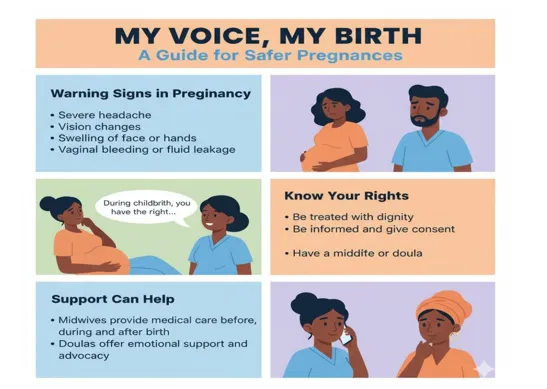
To facilitate maternal health literacy, a pictorial flyer, My Voice, My Birth: A Guide to Safer Pregnancies, has been prepared to aid in maternal health literacy. This will be comprised of warning signs of pregnancy, labor rights, the job of the midwife and the doula, as well as an emotional well-being plan. It employs real-life testimony and culturally appropriate examples that make both parts have a local artist. It has been shown that culturally specific, visually 3D educational resources have a positive effect on the understanding, memory, and trust towards the women who are pregnant, especially among low-literacy and underserved groups (Khan et al., 2024). The resource features informative, empowering, and trauma-informed language. The booklet will motivate early contact by the maternal services and solidify good decisions.
Slide 7:
Implementation
Slide 8:
Prenatal visit to the community-by-community health workers and midwives will be the introduction of the resource to the community. The booklet will be utilized in the local birth education programs in the form of a classroom resource. The topic of booklets will be supported in support groups, helped by reputable nonprofits and advocacy groups. It has been demonstrated that community-based prenatal education and midwife and health worker-led peer support programs are effective in enhancing maternal health literacy, level of attendance of prenatal care, and preventing avoidable complications (Ningrum et al., 2024). The groups will also be brochured in clinic waiting rooms, churches, and in the mobile health vans as a booklet. Personal reflection, questions, and peer support will also be identified through group discussions that are going to be facilitated.
Realistic Nature of Resource
Slide 9:
Continued availability is achieved via low-cost printing and good partnerships with NGO. The contents are more meaningful and more believable, as the message is contributed by community members. It depends on the distribution channels, which are based on the already existing maternal health activities without overlap of similar services. Community-based facilitators will promote the delivery of information, which will be respectful and customized (Falako et al., 2023). The model can be implemented by nurses, those in leadership positions of health services, and policymakers within local jurisdictions on a wider scale, focusing on health equity.
Closing Statement
Slide 10:
Maternity mortality has to be reduced beyond clinical solutions, needs to be met with compassion, cultural awareness, and advocacy on a community basis. With the education of women, building trust in local networks, and ensuring equal access to care, we will be able to bridge the gap in maternal outcomes. We as nurses and healthcare leaders can wield power to change policies, make a difference, and promote the right of all women to have a safe and dignified birth. We can welcome change to become a sustainable one and make sure that none of the mothers are abandoned.
References
Falako, S., Okoli, N., Boateng, M.-O., Sandoval, J., Gumudavelly, D., Larsuel, S. T., & Opara, I. (2023). Utilizing community-centered approaches to address black maternal mortality. Health Education & Behavior, 50(4), 500–504. https://doi.org/10.1177/10901981231177078
Hoyert, D. (2023, March 16). Maternal mortality rates in the United States, 2021. Cdc.gov. https://www.cdc.gov/nchs/data/hestat/maternal-mortality/2021/maternal-mortality-rates-2021.htm
Khan, M., Dave, A., Benton, M., Moss, N., & Kaler, M. K. (2024). Health literacy interventions for pregnant women with limited language proficiency in the country they live in: A systematic review. BioMed Central Public Health, 24(1). https://doi.org/10.1186/s12889-024-20747-8
Kozhimannil, K. B., Interrante, J. D., Carroll, C., Sheffield, E. C., Fritz, A. H., McGregor, A. J., & Handley, S. C. (2025). Obstetric care access continues to decline at rural and urban hospitals across U.S. states, 2010–2022. Health Affairs (Millwood), 44(7), 806–811. https://doi.org/10.1377/hlthaff.2024.01552
Ningrum, E. W., Lusmilasari, L., Huriyati, E., Marthias, T., & Hasanbasri, M. (2024). Improving maternal health literacy among low-income pregnant women: A systematic review. Narra J, 4(2), e886. https://doi.org/10.52225/narra.v4i2.886
Neves, J. A., de Vasconcelos, F. de A. G., Machado, M. L., Recine, E., Garcia, G. S., & de Medeiros, M. A. T. (2022). The Brazilian cash transfer program (Bolsa Família): A tool for reducing inequalities and achieving social rights in Brazil. Global Public Health, 17(1), 26–42. https://doi.org/10.1080/17441692.2020.1850828
Nove, A., Friberg, I. K., Bernis, L. de, McConville, F., Moran, A. C., Najjemba, M., Hoope-Bender, P. ten, Tracy, S., & Homer, C. S. E. (2020). Potential impact of midwives in preventing and reducing maternal and neonatal mortality and stillbirths: A lives saved tool modelling study. The Lancet Global Health, 9(1), 24-32. https://doi.org/10.1016/S2214-109X(20)30397-1
World Health Organization. (2025). Maternal mortality. Who.int. https://www.who.int/news-room/fact-sheets/detail/maternal-mortality